

For decades, the market has priced junior and mid-tier miners as optionality on a commodity price. Drill more holes, grow the resource, wait for the cycle to turn. The equity story lives and dies with the metal price deck.
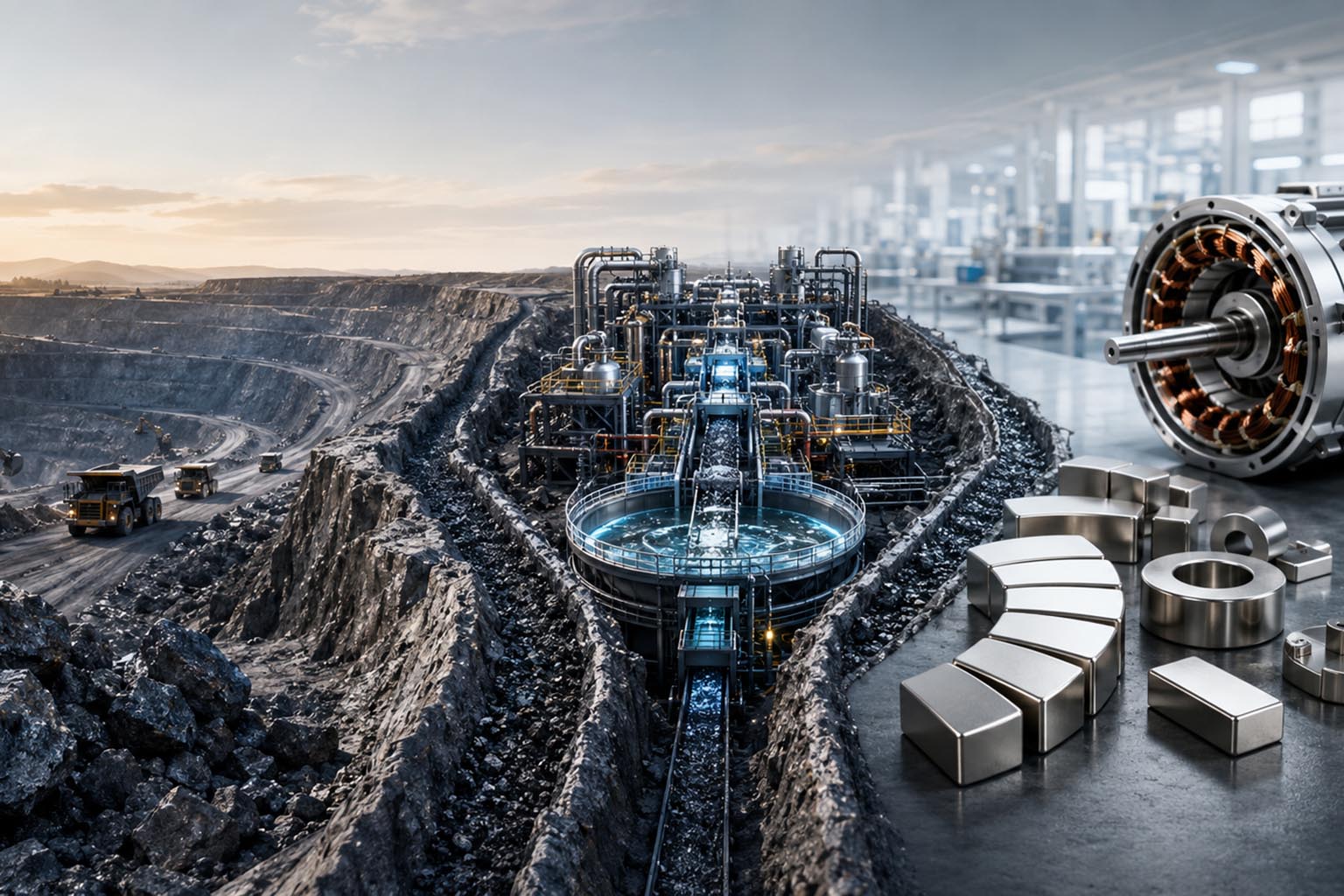
A growing cohort of operators is reviewing that script. Instead of simply owning ore, they're trying to own the bottleneck — the processing, refining, and manufacturing capacity that sits between raw material and finished product. It's a much harder business to build, but it may be a fundamentally superior line of thinking.
One template: Energy Fuels
Energy Fuels is the clearest case study. It started as a uranium producer but has spent years turning its White Mesa Mill into a rare earth processing facility. A scarce asset in the West adding separation, oxide production, and a heavy rare earth capability.
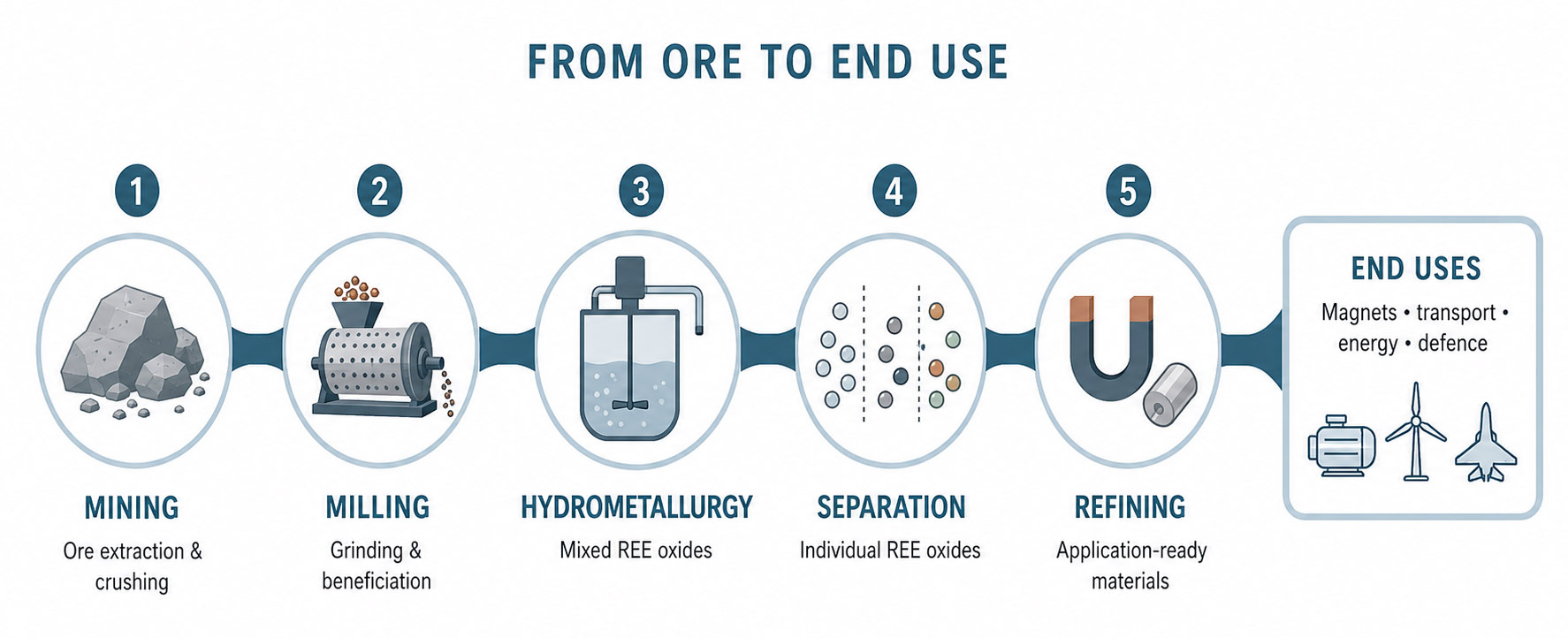
Recent M&A news sharpened the picture when Energy Fuels bought German magnet maker Vacuumschmelze (VAC) for roughly $1.9 billion, in a deal comprising $718 million in cash and new paper. This creates a full rare earth value chain, from feedstock and processing to finished magnets. VAC brings decades of production expertise, more than 400 patents and over 100 customers, as well as its South Carolina facility. Energy Fuels has hinted at $65–75 million in annual cash flow at current capacity. This acquisition follows last year's $300 million ASM transaction and combines US-based uranium and rare earth processing with ASM's Dubbo rare earths project, plus its Korean Metals subsidiary, KSMM.
Its monazite-based pathway (via the Donald Project in Australia) gives access to both light and heavy rare earths (Nd, Pr, Dy and Tb), essential for high-performance magnets in EVs and defence. This contrasts with bastnäsite-focused peers like MP Materials, which lack heavy REEs.
Execution of this approach across multiple jurisdictions is a bold task. The magnet market is unforgiving, and picky automotive and aerospace customers require years of qualification before they'll trust a supplier. Buying that capability upfront rather than building it from scratch is a rational shortcut to getting a customer to sign off on your metallurgy.
The pattern repeats across the ‘criticals’ sector
Energy Fuels isn't alone. Here’s a shortlist of comparable movers. Others are visible on the SCOTdata site; feel free to browse our rare earths and lithium stock collections.
MP Materials — moved from selling concentrate to China, toward separation, oxide production and magnet manufacturing, explicitly framing itself as rebuilding an American rare earth supply chain.
Iluka Resources — from mineral sands producer to operator of Australia's first integrated rare earth refinery at Eneabba, arguably now more strategically significant than its mines.
Lynas Rare Earths — the original template: cracking, leaching, separation and oxide production layered on top of Mt Weld, to the point where its processing expertise is arguably valued as highly as the ore body itself.
PLS Group (Pilbara Minerals) — pursued lithium hydroxide conversion via its POSCO joint venture, recognising that the chemical conversion step captures more value than concentrate sales alone.
Syrah Resources — pushed from graphite concentrate into active anode material production in the US, a genuine move from mining into battery manufacturing inputs.
Neo Performance Materials — not a miner at all, but a useful illustration of where value accumulates: separation, metal, magnet powders, finished materials.
South32 — a less obvious case, but its aluminium smelting and manganese alloy production show that downstream commitment long predates the current rare earth narrative.
Beyond the majors, copper shows how rare this move remains, with Freeport-McMoRan, KGHM and Aurubis among the few with smelting, refining or cathode production.
Why so few attempt it?
The economics explain the scarcity: processing plants are not cheap. Metallurgical risk is real and technical, and the required chemistry skills come with a language quite alien to geologists and mine builders. Given all that, it's unsurprising that equity markets have historically rewarded resource growth over downstream integration. It's the easier story to tell and the easier business to run.
The thesis: a different source of value, not just more of it
The SCOTdata version of this argument isn't that downstream integration always creates more value. It’s that a customer-facing downstream focus changes what future value depends on.
The pure upstream operators remain hostage to forces that have little to do with geology: the commodity cycle, financing windows, and so on. Perhaps the greatest hurdle lies in managing and projecting a culture of cost discipline during the early years where there is almost no concept of ‘on time, on budget’ delivery to a real ‘customer’. Shareholders can always be fobbed off with another imaginative press release.
An integrated operator is instead exposed to a different set of variables — processing scarcity, technical know-how, customer qualification status, offtake relationships, and the geopolitical push to diversify critical mineral supply chains away from China.
The downstream processor offers a new margin from capability. That capability is scarcer, stickier and harder for a generalist investor to price using a standard NAV model — which is exactly why it may command a different kind of premium, and why it may also draw a different kind of capital. Processing and refining assets increasingly qualify for strategic government financing — loan guarantees, defence-related programmes and critical minerals funding — that pure exploration and mining assets simply cannot access. Energy Fuels' own VAC transaction sits alongside a separately announced government loan facility, which is itself a signal of how differently capital treats integrated platforms.
There's a counter-case worth holding onto. Many mining investors specifically want clean commodity-price exposure, not diversification into lower-margin, higher-capex downstream assets which can look like empire-building if execution falters. The market won’t reward vertical integration automatically — but we’re watching out for signs that selective downstream exposure changes the risk profile investors are pricing.
Where this goes next?
This may still look like a handful of anecdotes, but here’s a potted summary against the VanEck Rare Earth and Strategic Metals ETF (REMX) — the closest thing to a sector benchmark, tracking the MVIS Global Rare Earth/Strategic Metals Index, which returned +86% since 1 January 2025.
| Company | Ticker | Return |
|---|---|---|
| REMX ETF | REMX | +86% |
| Energy Fuels | NYSE: UUUU | +124% |
| MP Materials | NYSE: MP | +190% |
| Lynas Rare Earths | ASX: LYC | +147% |
| Iluka Resources | ASX: ILU | +21% |
| Pilbara Minerals (now PLS Group) | ASX: PLS | +98% |
| Syrah Resources | ASX: SYR | −46% Thinly traded and extremely volatile |
To be continued — and, as always, food for thought only, not investment advice.