

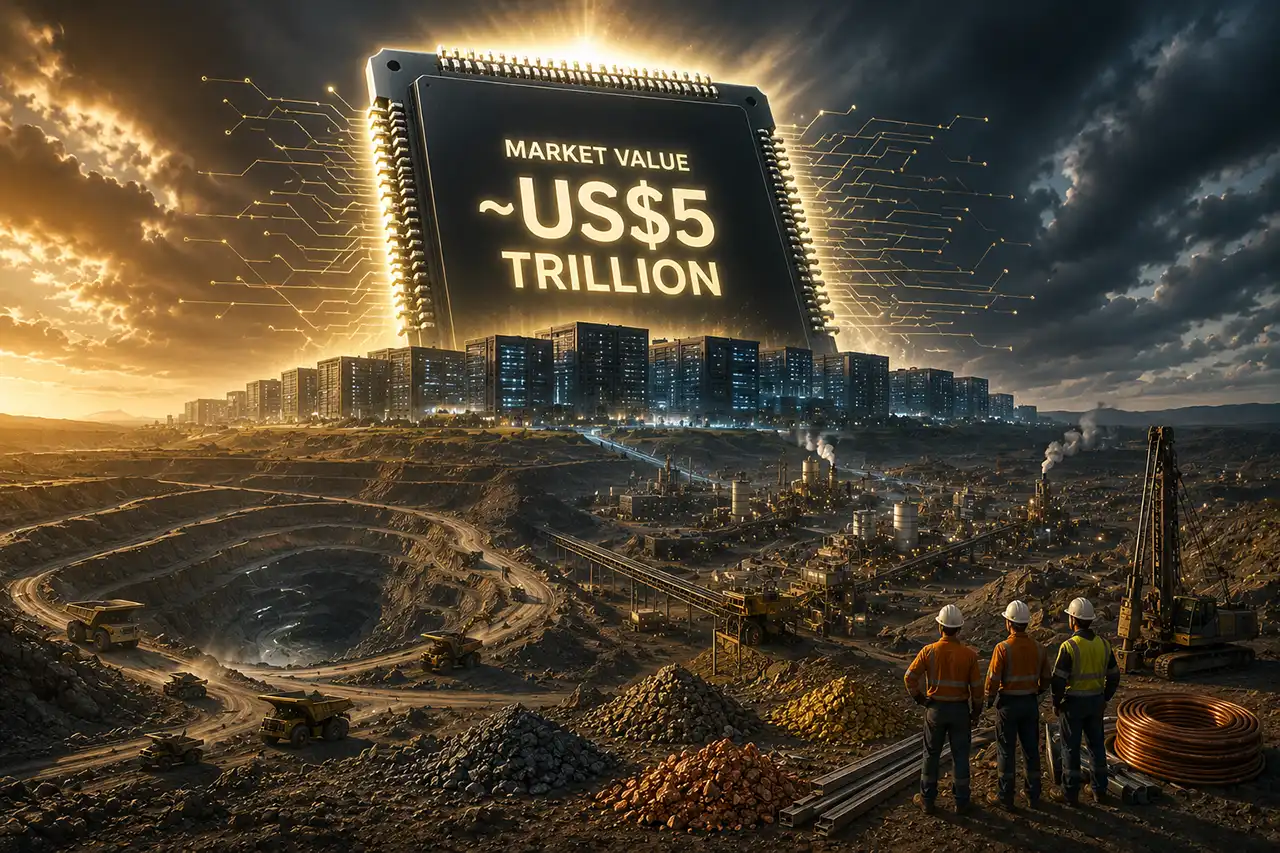
There is something wonderfully deranged about modern capital markets.
With an open-mind, I try not to become the sort of embittered relic muttering about “real assets” while semiconductor executives levitate toward trillion-dollar sainthood on CNBC.
And yet.
At roughly US$5 trillion, NVIDIA Corporation has now entered a valuation category that can only be described as "post-geological."
Not post-industrial. Post-geological.
Because for roughly the same amount of money — perhaps less, depending on the day's market spasms — one could conceivably acquire the entire quoted upstream mining industry on Planet Earth.
Not just a few miners.
All of them.
The whole filthy, glorious, dirt-under-the-fingernails complex.
Imagine the shopping list.
You acquire: BHP Group, Rio Tinto, Glencore, Vale S.A., Freeport-McMoRan, Anglo American plc, Newmont Corporation, Barrick Mining Corporation, Southern Copper Corporation, Teck Resources, First Quantum Minerals, Agnico Eagle Mines Limited, Wheaton Precious Metals and Franco-Nevada.
Then, because we are operating with Silicon Valley numbers now, you continue.
You sweep up: copper developers, silver optionality plays, uranium renaissance basket, nickel dreamers, lithium disappointments, graphite vision decks, molybdenum specialists, rare earth "strategic critical minerals" conferences held in airport hotels.
Every TSX Venture explorer with: three drill holes, one moose photo, an inferred resource, and a market cap smaller than a suburban Waitrose.
You buy them all.
The producing mines. The projects. The royalties. The tailings. The camps. The haul trucks. The processing plants. The core sheds. The water permits. The geologists. The Peruvian community relations teams. The Chilean desalination pipelines. The Australian fly-in fly-out villages. The entire global inventory of fluorescent drill jackets.
For the valuation of one AI semiconductor company.
And here is the uncomfortable punchline:
Unlike software narratives, the mining industry ACTUALLY OWNS things.
Things civilisation physically requires: copper, iron ore, gold, silver, nickel, uranium, metallurgical coal, potash, molybdenum and rare earths.
The periodic table does not pivot to SaaS.
Every AI datacentre narrative eventually collides with brutal material reality: copper wire, steel, concrete, transformers, diesel, turbines, arrays, transmission infrastructure, cooling systems, and staggering electricity demand.
The future arrives dug out of the ground by exhausted people in hard hats.
One cannot "disrupt" the laws of thermodynamics with a keynote presentation.
And yet markets currently imply something extraordinary:
that the supplier of AI chips deserves a valuation rivalling the cumulative enterprise value of the companies extracting the raw materials required to build industrial civilisation.
It is as though investors have become mesmerised by the casino upstairs while forgetting the building still requires foundations.
As we respectfully second guess the 2026 year-end conclusions, we imagine an alternate deployment strategy for US$5 trillion.
Instead of buying a momentum narrative at 35 times sales, we acquire:
- the world's tier-one copper belts,
- the dominant uranium districts,
- half the gold reserves in North America,
- strategic silver optionality,
- lithium brine basins,
- royalty portfolios with 100-year duration,
- and enough undeveloped deposits to make resource nationalists visibly nervous.
We corner future scarcity itself. Then we wait.
Because unlike social media platforms or software layers, ore bodies do not care about quarterly sentiment.
Grades decline. Discoveries diminish. Permitting worsens. Energy costs rise. Governments panic. Replacement reserves disappear.
Meanwhile humanity decides simultaneously to: electrify transport, build AI infrastructure, expand grids, construct datacentres, decarbonise industry, reindustrialise strategically, and consume exponentially more power. All of that while colonising Mars.
This may prove mildly copper intensive.
As our global energy, transport, infrastructure, and defence systems modernize, we need copper. A lot of it. By 2050, we must double global copper mining and refining capacity - this means mining and refining more copper in the next 25 years than in all human history combined.
The greatest irony of the Mag 7 era is that the market has awarded astronomical valuations to the downstream beneficiaries of abundance while largely neglecting the upstream owners of scarcity.
History rarely leaves such imbalances unresolved forever.
Of course, NVIDIA may continue compounding brilliantly. AI may reshape productivity beyond anything currently imaginable.
But if one company reaches a valuation where its equity value can plausibly purchase:
- nearly every meaningful mining company on Earth,
- the global inventory of future metal discoveries,
- and much of the raw material foundation of modern civilisation itself,
then perhaps the question is no longer: "Is NVIDIA a fabulous company?"
Perhaps the better question is: "What exactly have markets decided reality is worth?"
It’s a self-serving conclusion for us rock types and our timing will be slightly out
- but the conclusion is obvious.